
How Storm Damage Affects Tree Health in NYC and When Removal Becomes Necessary
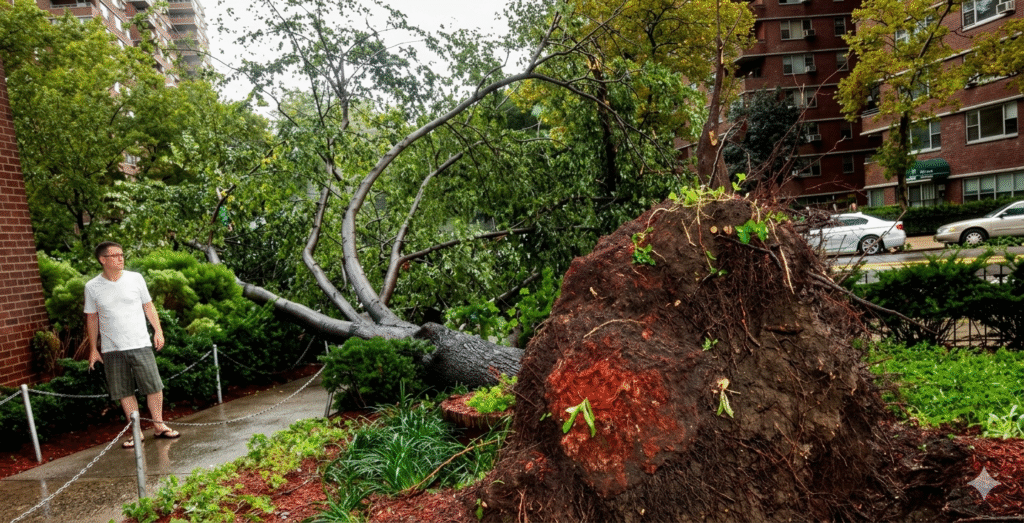
The U.S. Forest Service estimates that a big tree may lose up to 30% of its root system during a big storm and not noticeably decline in appearance for weeks. That one figure is why so many trees around NYC that are affected by the storm fall down several months after the storm that caused the damage. A nor’easter or summer microburst can set back decades of a tree’s growth in a few hours and throughout New York City’s five boroughs, storm season leaves behind more than broken branches and strewn sidewalks, but trees with hidden wounds that may fester for years after storms pass. The first step in protecting your property, your family and the urban canopy that makes NYC neighborhoods livable is to understand how storms affect the structural integrity of trees. Why NYC Trees Are Especially Vulnerable to Storm Damage Urban trees are under different stresses than rural trees and thus are more vulnerable to storm damage initially. City soil compaction reduces root extension, causing many NYC street trees to have weaker, shallower root systems before a storm comes. Combine limited growing room due to sidewalks, utility lines, building foundations, and you have trees that do not have the structural “runway” to take the high winds like a forest-grown tree would. Many Bronx and NYC trees are also chronically weakened by urban heat island effects and years of soil stress due to road salt, pollution, and minimal water infiltration. If a tree is already under stress from these environmental factors, a storm impacts the tree, the damage is compounded and the recovery period is shortened. This is why two trees of the same species and age can respond completely differently to the same storm one may shake off a wind event with minor pruning needs, while the other suffers catastrophic structural failure. The Hidden Toll of Storm Damage on Tree Health A tree’s damage is not always apparent when high winds, heavy snow, or flooding occur. One of the most under-estimated effects of extreme weather is root system disturbance. Wet soil and high wind can cause a tree’s root plate to become loose, and it may not be apparent until the next storm knocks it over completely. Many homeowners think that a tree “survived” a storm because it is still upright, but actually the root structure has already been damaged and the tree is unstable. Bark splitting and cambium damage are equally serious, if less obvious to an untrained eye. Just below the bark is the cambium layer which moves nutrients and water around the tree. If ice, falling debris or wind penetrates this layer, it allows the fungus pathogens and wood-decay organisms to invade, causing the gradual hollowing of limbs and trunks over the following seasons. Canopy stress also plays a major role in long-term decline. A tree that has lost a substantial amount of its foliage during a storm will not be able to photosynthesize at its best, and its overall vigor will be decreased, which can make it more susceptible to pests and diseases such as the Asian longhorned beetle, known to be a serious hardwood tree threat in NYC. A wind-denuded canopy also produces reduced shade and cooling for adjacent property, impacting such costs as energy bills and even other plant health. Internal cracking, meanwhile, is perhaps the most dangerous type of storm injury because it’s almost entirely invisible without a trained assessment. In some instances, micro fractures within a trunk or large limb may occur as a result of the flexing stresses of strong winds, and may not show any external signs until the tree’s load-bearing ability is severely compromised. Warning Signs That Demand Professional Evaluation Even though not all trees that are damaged need to be removed, some warning signs cannot be ignored. Means of safety hazard to pedestrian, vehicle and building below is hanging or partially attached limbs, which should be considered as emergency rather than routine maintenance. Deep structural weakness is indicated by vertical trunk cracks and the inclusion of bark at the branch unions; it is likely to fail if subjected to future stresses, even though it may not appear otherwise unhealthy. Homeowners should also watch for soil heaving around the base of a tree a subtle mound or crack in the ground near the root flare that indicates the root system has already begun to shift. This is usually the most obvious indication that a tree’s balance has been upset to an irreparable degree, and in conjunction with an obvious lean that was not there before the storm. A sudden lean following a storm is a much more serious situation than a tree has been leaning for years. Another important sign is if the trunk or exposed roots have mushroom or fungal conks growing on them. The fruiting bodies are signs of inner rot often occurring long before the storm and with the storm just hastening the inevitable death of an already compromised tree. Another indicator to watch for is the accumulation of deadwood in the upper canopy after a storm, as dead limbs are more likely to fall in subsequent storms. When Tree Removal Becomes the Safer Choice The general rule of thumb for certified arborists is to remove trees that exhibit more than 50% crown dieback, have significant trunk cracks, or have root instability that could pose a threat to surrounding structures. In NYC neighborhoods where lots are built adjacent to one another, and trees stand tall next to brownstones, sidewalks and power lines, there is little margin for error. A tree that may survive in a rural landscape may not be able to survive in an urban landscape where one dropped limb could destroy a house, a car or a pedestrian. Risk assessment should always weigh the tree’s proximity to structures, its species’ typical failure patterns, and the extent of internal decay. Certain species, such as Bradford pear or silver maple, commonly found throughout the Bronx and greater NYC area are