In New York City, the majority of the damage to trees in relation to construction is not done during storms or heat waves but instead done very quietly, during authorized building work. When a sidewalk replacement, a foundation dig, or a utility trench is cut into the same thin layer of soil where urban tree roots are preserved, it is in the same shallow layer of soil. Months later, a healthy tree in the street starts failing, and the property owner has to contend with infractions, estoppel expenses, or liability issues.
The trees in NYC are planted in highly constrained, stressed conditions, whereas all trees in the suburban or rural environments are much less susceptible to the damage associated with construction. This guide mentions exactly how construction harms the surrounding trees in NYC, what the initial warning signs should be observed, and what the preventative measures and recovery strategies really do in the urban environment.
Why NYC trees are uniquely vulnerable during construction
The trees in NYC already have to endure stress in the city. And add building, and the margin on survival is absolutely slender.
Some of the NYC-specific vulnerabilities are:
- Poor access to root zones by sidewalks, curbs, basements, utilities, and vaults.
- The soils of the compacted cities are low in oxygen and poorly drained.
- Root system in street and yard trees.
- Regulatory issues between DOB permits, DOT sidewalks, and the trees of the Parks Department.
Contrary to trees in a forest, NYC trees are supported by a small share of working soil. Even destroying 10-20% of the root system, and degradation may set in within weeks.
The most common ways construction damages nearby trees
1. Root severing during excavation and trenching
Root cutting is the most devastating and widespread problem of construction in NYC.
During:
- Foundation excavation
- Utility trenching (gas, water, sewer, electric)
- Sidewalk replacement
- Drainage or waterproofing job.
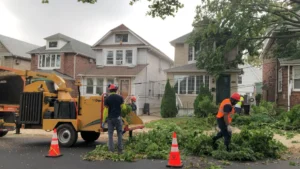
There is regular cutting of structural and feeder roots without evaluation.
Why this is catastrophic in NYC:
- The majority of tree roots lie in the 12-24 inches of soil.
- Roots usually go 2-3 times the width of the canopy.
- Felling of large roots makes trees unstable and interferes with the uptake of water.
The immediate and delayed effects are:
- Sudden leaf drop or scorch
- Reduced canopy density
- Leaning or instability
- Increased risk of windthrow
- Delayed death 6-36 months delayed.
2. Soil compaction from heavy equipment and staging
A tree can die alone by being compacted by soil, even without the cutting of roots.
Common NYC scenarios:
- Dumpsters are set on root zones.
- Excavators were parked under canopies.
- Staged pallets of brick, cement,nt or steel in front of trunks.
Compaction reduces:
- Oxygen availability
- Water infiltration
- Microbial activity
- Regeneration and growth of roots.
Roots can be forced into suffocation in already compacted soils in NYC during the construction compaction.
Symptoms are frequent and tend to manifest slowly:
- Fewer and fewer leaves each year.
- Sparse canopy
- Chronic dieback
- Pathogens take advantage of root weakness.
3. Grade changes and soil level alterations
After waterproofing the basement trunks, backfilling against the trunks.
Even a 2-4 inch grade change can:
- Smother surface roots
- Alter the moisture balance
- Root flare triggers trunk rot.
Trees are made to fit accurately to the soil-to-trunk relationship.
- Trunk and bark damage from equipment and materials
The destruction of the bark is not a cosmetic one, but rather a vascular one.
Typical NYC causes:
- Skid steer contact
- Scaffolding installation
- Against trunks, materials were bent.
- Trees tied with chains and cables.
Bark injuries disrupt nutrient flow and provide access points to:
- Decay fungi
- Insect pests
- Bacterial infections
5. Chemical exposure and construction runoff
Construction brings with it substances that are not geared towards trees.
High-risk exposures include:
- Concrete washout (highly alkaline)
- Mortar dust
- Fuel and hydraulic leaks
- Salt is used to de-ice prematurely.
Even concrete runoff has the potential of increasing the soil pH to levels that cannot sustain life, thus sterilizing the root zone.
NYC regulations most contractors ignore—but trees pay for
Most property owners believe that the protection of trees is optional. In NYC, it is not.
Key regulatory realities:
- The NYC Parks owns and controls street trees.
- Many of the permitted projects need Tree Protection Plans (TPP).
- Deforestation of safeguarded trees may lead to fines, stop-work orders, and required replacement.
Nevertheless, enforcement is usually done when the damage is visible, and not when it might have been avoided.
Early warning signs that your tree is being damaged by construction
Watch these NYC red flags:
- Leaves are drying even with frequent watering.
- Abrupt weakness on the construction side.
- The appearance of cracks in the soil near the trunk.
- New lean after excavation
- Mushrooms in the base, or fungus.
How to protect trees before construction starts
Root zone mapping and exclusion areas
Before any digging:
- Determine the Critical Root Zone (CRZ).
- Mark no-dig and no-storage boundaries.
- Where feasible, reposition foundation lines and trench paths.
Effective fencing of trees (not orange cones).
Effective fencing must:
- Be rigid and immovable
- Where possible, enclose the whole CRZ.
- Eliminate foot and equipment traffic.
Air excavation instead of mechanical digging
Where roots are present:
- In air spading, roots are not cut off.
- Enables routing of utilities around critical roots.
- Stabilizes stability and uptake capacity.
Load distribution and soil protection systems.
When access is unavoidable:
- Use ground protection mats
- Distribution of loads on a broader scale.
- Block pressure at root zones.
Recovery options when damage has already occurred
Not every damage caused by the construction can be fatal when dealt with in time and properly.
Root zone remediation
Includes:
- Excavation of the air to determine the damage.
- Selective root pruning
- Soil decompaction
- Organic modifications to NYC soils.
Stability and stress-reduction pruning Structural pruning.
When roots are lost:
- Lessen canopy load strategically.
- Enhance body weight distribution.
- Lower wind resistance
It is not cosmetic pruning; it is risk management.
Correction of soil chemistry and drainage.
The soils that are built after construction are usually:
- Over-alkaline
- Compacted
- Hydrophobic
Ongoing monitoring and risk assessment
- Damaged trees require:
- Seasonal evaluations
- Stability monitoring
- Decay detection
Why generic tree care advice fails in NYC
Most online advice ignores:
- NYC soil composition
- Conflict of high-density infrastructure.
- Regulatory complexity
- Block to block block variability.
Recovery of trees in the city is not a hobby.
The cost of ignoring construction-related tree damage
Loss of the chance to repair damage may result in:
- Emergency removals
- Legal responsibility in property destruction.
- DOB violations
- Loss of property value
The replacement costs of the tree are mandatory.
Conclusion: Protect the tree before the permit becomes a problem
Trees and construction can get along in NYC–only with proper planning and professional interference. Getting a renovation started, you are experiencing the fall after the construction, or you have a tree that is no longer safe, a professional presence at the beginning is a difference maker.
This is the ideal time to do it if you have a project that requires excavation, foundation work, or changes to the sidewalks. Contact specialists in NYC tree protection, post-construction recovery, tree emergency services, and professional tree risk evaluation.
In the case of solutions that are experienced and city-specific, make contact with NYC Tree Pro. They deal with tree protection, tree health restoration, and the hazardous tree assessment of their construction-related business.